AI contact center companies help organizations modernize customer support and sales conversations using technologies like natural language processing, machine learning, and automation. The result is typically faster resolutions, more consistent service, better insights, and happier agents who spend less time on repetitive tasks. An contact center omnichannel services approach ensures these improvements are seamless across all customer touchpoints.
This guide breaks down what these companies provide, the most valuable capabilities to look for, how to evaluate fit, and how to plan a rollout that delivers measurable improvements without disrupting your operations. These capabilities reflect AI contact center engagement transformation.
As part of evaluating solutions, reviewing contact center AI pricing is essential. Pricing can vary based on features such as virtual agents, agent assist, analytics, automation, and interaction volume. Understanding pricing structures upfront helps organizations align investments with expected outcomes, scale efficiently, and ensure that AI initiatives deliver tangible improvements in both customer experience and operational performance.
What “AI Contact Center Company” Means (and What It Doesn’t)
An AI contact center company generally falls into one of these categories:
- Contact center platforms that embed AI into core routing, self-service, agent tools, and analytics (often delivered as cloud software).
- AI solution providers that integrate with your existing contact center to add specific capabilities like virtual agents, quality management, or agent assist.
- System integrators and managed service providers that implement, customize, and operate ai contact center solutions for enterprises
What it doesn’t necessarily mean: a “fully autonomous” customer service operation. In practice, AI is most effective when it handles high-volume, repeatable interactions and supports human agents on complex, emotional, or high-stakes cases—showcasing the value of ai contact center software and the impact of ai contact center automation in delivering efficient, intelligent, and scalable customer support.
Why Organizations Choose AI Contact Center Companies
AI initiatives in the contact center are often funded because they create compounding operational benefits. Common outcomes include:
- Shorter customer wait times through better routing and improved self-service containment.
- Higher first-contact resolution as agents find answers faster and follow consistent workflows.
- More consistent service quality using automated evaluations and real-time coaching cues.
- Lower cost per contact by shifting routine questions to self-service and reducing rework.
- Higher agent satisfaction when repetitive after-call work and searching across systems is reduced.
- Better visibility into why customers contact you, what they feel, and what drives escalations.
AI contact center companies typically position their offerings around a simple promise: make every interaction easier for both customers and agents.
Top AI Contact Center Companies
AI contact center companies provide platforms and services that combine automation, artificial intelligence, and analytics to improve customer engagement. These solutions help businesses reduce costs, enhance agent productivity, and deliver consistent, omnichannel experiences at scale.
Here are some of the top AI contact center companies:
1. Bright Pattern — Leading AI Contact Center Company

Bright Pattern is a market-leading AI contact center company offering a comprehensive, enterprise-ready platform that combines automation, omnichannel engagement, and real-time agent support. It is designed to help organizations increase efficiency, reduce operational costs, and improve customer satisfaction.
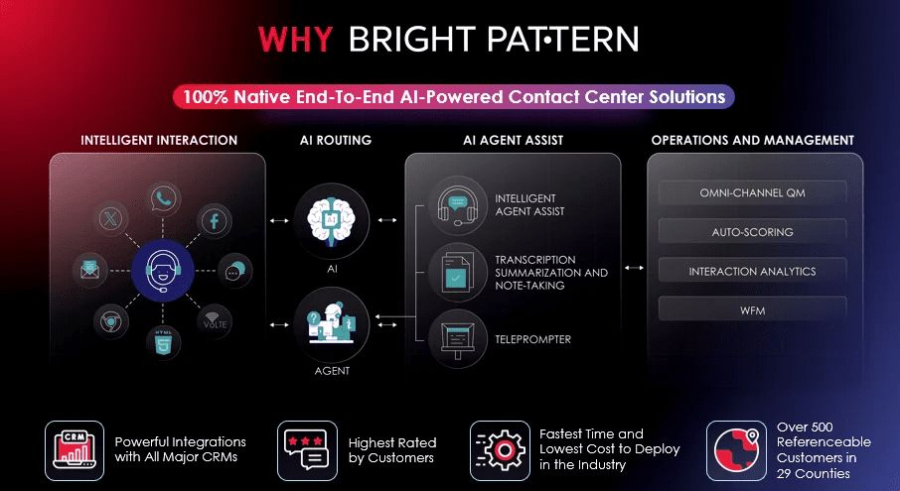
Key Features and Commercial Benefits:
- Automated virtual agents handle high-volume interactions such as FAQs, billing questions, order tracking, appointment scheduling, and returns. This reduces workload for live agents and lowers operational costs.
- Intelligent routing ensures customers are directed to the most suitable agent based on skills, sentiment, history, and predicted needs, improving first-contact resolution and reducing wait times.
- Omnichannel engagement allows seamless communication across voice, chat, email, SMS, messaging apps, and video without losing conversation context.
- Real-time agent assistance provides suggested responses, knowledge articles, and next-best actions, increasing agent efficiency and accuracy.
- Workflow automation reduces manual tasks such as ticket creation, follow-ups, notifications, and surveys.
- Predictive analytics and reporting track interaction trends, customer sentiment, and agent performance to optimize workflows and staffing.
- Integration services connect Bright Pattern to CRM, workforce management, and marketing platforms, leveraging existing investments.
- Proactive engagement allows automated notifications for service updates, promotions, and delays, reducing inbound contacts and improving customer experience.
- Enterprise scalability and security support global operations with compliance-ready features and disaster recovery.
- Measurable commercial ROI: Enterprises using Bright Pattern report lower handling times, higher customer satisfaction, and reduced costs, making it a high-value investment for large-scale operations.
Bright Pattern is trusted by enterprises in healthcare, finance, retail, and telecommunications for scalable, reliable, and intelligent AI contact center solutions.
2. Genesys Cloud CX
Genesys Cloud CX offers AI-powered predictive engagement, intelligent routing, and workforce optimization. Its solutions allow enterprises to deliver personalized, proactive support and improve operational efficiency at scale.
3. NICE CXone
NICE CXone combines AI automation with workforce optimization, quality management, and analytics. It provides real-time coaching, sentiment analysis, and automation to improve agent performance and customer satisfaction.
4. Talkdesk
Talkdesk provides AI-powered virtual agents, workflow automation, and real-time agent assistance. Its solutions help businesses scale operations, automate routine tasks, and improve customer response times.
5. Amazon Connect
Amazon Connect integrates AI technologies such as Amazon Lex and Contact Lens for virtual agent interactions, sentiment analysis, and speech-to-text analytics, enabling cloud-native, enterprise-scale automation.
6. Zendesk
Zendesk offers AI-powered ticket routing, conversational bots, and knowledge base recommendations, helping businesses reduce manual workload and resolve customer inquiries faster.
7. Microsoft Dynamics 365 Customer Service
Microsoft Dynamics 365 combines AI with CRM functionality to provide virtual agents, predictive case routing, and real-time agent guidance, helping enterprises deliver efficient and personalized customer support.
8. Google Cloud Contact Center AI (CCAI)
Google CCAI offers enterprise AI services including virtual agent orchestration, real-time agent assistance, speech-to-text analytics, and sentiment detection to optimize workflows and improve customer satisfaction.
9. Salesforce Service Cloud + Einstein AI
Salesforce Einstein integrates AI into Service Cloud for intelligent case routing, predictive recommendations, workflow automation, and agent assistance, enhancing agent efficiency and customer satisfaction.
10. Five9
Five9 provides AI virtual agents, smart IVR, and real-time agent assist, helping businesses automate repetitive tasks and optimize contact center operations at scale.
Core Capabilities Offered by AI Contact Center Companies
Different vendors emphasize different strengths, but most solutions cluster into a few key capability areas.
1) AI Self-Service (Virtual Agents and Voice Bots)
AI self-service is designed to resolve routine requests end-to-end, such as order status, appointment scheduling, password resets, or store information. Modern implementations often include:
- Conversational interfaces for chat and voice that interpret intent and entities (like account numbers, dates, locations).
- Knowledge-based answers sourced from FAQs, policy documents, and help center content.
- Workflow automation that connects to back-end systems to complete tasks (for example, checking a balance or updating contact details).
- Smart handoff that escalates to a live agent with full context when confidence is low or a customer requests a person.
When designed well, self-service improves accessibility and responsiveness without forcing customers into rigid menus.
2) Agent Assist (Real-Time Guidance During Conversations)
Agent assist tools listen to or read conversations in real time and support the agent with:
- Suggested answers and knowledge articles based on what the customer is asking.
- Next-best actions aligned to policy and process, reducing time spent searching.
- Call summaries and after-call work automation to reduce repetitive documentation.
- Compliance prompts and reminders (for example, required disclosures) where appropriate.
This capability is especially valuable for new hires and for teams supporting complex products with frequent updates.
3) Intelligent Routing and Workforce Optimization
AI-enabled routing aims to match customers with the best available resource, considering factors like language, intent, customer value, channel, and agent skills. Workforce optimization features may include:
- Forecasting and scheduling improvements using historical and seasonal patterns.
- Skills-based and intent-based routing to reduce transfers.
- Queue insights to identify emerging issues before they become volume spikes.
Routing and staffing improvements can deliver fast operational wins because they impact every interaction.
4) Quality Management and Conversation Analytics
AI contact center companies frequently offer analytics that go beyond traditional dashboards:
- Speech and text analytics to detect topics, sentiment signals, and recurring friction points.
- Automated QA that evaluates more interactions than manual sampling can.
- Coaching insights that identify which behaviors correlate with better outcomes.
The biggest advantage is coverage and consistency: leaders can spot systemic issues earlier and improve training faster.
5) Knowledge Management That Improves Over Time
Many AI deployments succeed or fail based on knowledge quality. Strong vendors provide:
- Centralized content management for agent and customer-facing knowledge.
- Search relevance tuning and feedback loops (thumbs up or down, “did this help?” signals).
- Content governance so policy updates propagate quickly and reliably.
In practice, your knowledge base is the fuel for both self-service and agent assist.
How AI Contact Center Companies Differ (What to Compare)
Two offerings can both be labeled “AI contact center,” yet produce very different outcomes. The differences usually come down to the following:
End-to-End Platform vs. Add-On Solutions
- End-to-end platforms can simplify vendor management and reduce integration overhead.
- Specialized add-ons can be ideal if you already have a stable contact center stack and want targeted improvements.
AI Maturity and Operational Fit
Some solutions are optimized for quick deployment with standard use cases. Others are geared toward deeper customization, more complex workflows, and high governance requirements.
Channel Strength
One vendor may excel at voice; another may shine in digital channels like chat, messaging, or email. Evaluate based on where your customers actually contact you today and where you plan to grow.
Data and Integration Approach
Integration quality affects how “intelligent” the AI feels. Look for how well the system connects to your CRM, order management, identity systems, and knowledge base. If the AI can’t access the right data safely, it can’t resolve the right problems.
Governance, Security, and Compliance Readiness
Enterprise teams often need strong admin controls, audit logs, data retention options, and support for compliance obligations relevant to their industry and region.
A Practical Feature Checklist (What to Expect From Strong Vendors)
Use the checklist below to compare AI contact center companies in a structured way.
| Capability Area | What “Good” Looks Like | Why It Matters |
|---|---|---|
| Virtual agent handoff | Seamless escalation with full transcript and customer context | Prevents customer frustration and reduces repeat questions |
| Agent assist | Real-time suggestions, fast search, and configurable workflows | Speeds resolution and supports consistent policy adherence |
| Knowledge management | Governed content lifecycle, feedback loops, and strong search | Improves answer accuracy across both bots and humans |
| Analytics | Topic detection, trends, and actionable insights, not just charts | Turns conversations into operational improvements |
| Admin controls | Role-based access, auditability, environment separation | Supports safe scaling across teams and regions |
| Integration | Robust connectors or APIs to core systems (CRM, ticketing, identity) | Enables real resolution, not just scripted responses |
| Customization | Configurable intents, flows, and policies without heavy engineering | Speeds iteration and keeps ownership with operations teams |
Persuasive Use Cases: Where AI Delivers Fast Wins
If you’re prioritizing initiatives, these are common areas where AI contact center companies can help you create visible momentum.
High-Volume FAQs and Status Checks
Examples include shipping status, appointment confirmation, store hours, policy questions, and account updates. These are ideal because they are frequent, predictable, and easy to validate.
Peak Volume Support
AI self-service and smarter routing can act as a pressure-release valve during seasonal spikes, promotions, and unexpected events. Even partial automation can protect service levels by keeping queues manageable.
New Agent Ramp-Up
Agent assist reduces the time it takes for new hires to become confident and accurate. With real-time guidance and knowledge suggestions, teams can maintain quality even as hiring scales.
After-Call Work Reduction
Automated summaries and structured wrap-up support help agents close interactions faster and more consistently, which can improve both reporting quality and customer follow-up.
Quality and Coaching at Scale
Instead of relying primarily on small QA samples, analytics can highlight recurring issues, support targeted coaching, and surface process gaps that drive repeat contacts.
Example Success Stories (Realistic, Anonymized Scenarios)
To illustrate what “good” can look like in practice, here are common patterns organizations achieve when they select the right AI contact center company and roll out thoughtfully.
Scenario A: Retail Customer Service Becomes Faster and More Consistent
A multi-location retailer implements a virtual agent for order status, returns policies, and store information. Customers get quick answers during peak periods, and agents receive fewer repetitive inquiries. The support team then uses conversation analytics to identify confusing policy wording and updates the knowledge base, improving both bot responses and agent performance.
Scenario B: A Service Provider Improves First-Contact Resolution
A service provider adds agent assist for troubleshooting flows and knowledge retrieval. During calls, agents get suggested steps based on the customer’s issue, reducing transfers and keeping interactions focused. Leaders use analytics to find the most common failure points in the process and fix them upstream.
Scenario C: A Growing Team Scales Without Sacrificing Experience
A fast-growing business expands support rapidly. AI-powered coaching cues, standardized knowledge, and automated wrap-up help new hires deliver accurate service earlier in their tenure, improving customer experience while protecting team morale.
How to Choose Among AI Contact Center Companies
Selection tends to go best when you evaluate solutions against your specific operational reality, not a generic feature list.
Step 1: Define Your “North Star” Outcomes
Choose a small set of measurable outcomes and align stakeholders early. Examples include:
- Improved customer experience (for example, reduced effort and fewer transfers)
- Increased agent productivity (less searching and manual work)
- Higher self-service completion for targeted intents
- Better consistency and compliance through guided workflows
Step 2: Inventory Your Interaction Types
List your top contact drivers by volume and complexity. Identify which are best for:
- Automation (repeatable, low risk, clear success criteria)
- Assistance (complex but standardized steps)
- Human-only (high empathy, high variability, sensitive outcomes)
Step 3: Evaluate Data Readiness
AI works best when it can safely access accurate data and knowledge. Confirm:
- Where your knowledge lives and who owns it
- What systems must be connected to complete workflows
- Data quality and identity matching (to avoid wrong-account actions)
Step 4: Run a Proof of Value With Real Work
A strong evaluation goes beyond demos. Aim for a controlled pilot that uses:
- Your real knowledge content
- Your common intents and call drivers
- Your integration requirements (even if limited at first)
- Your operational KPIs and QA definitions
Step 5: Assess Long-Term Scalability
Ask how the solution supports ongoing improvement:
- Can business users tune intents and content without heavy development?
- How are changes tested and deployed?
- How are analytics translated into workflow and content updates?
Questions to Ask AI Contact Center Companies (Use This in RFPs and Demos)
- Handoff and context: When the bot escalates, what exactly does the agent see, and how quickly?
- Knowledge governance: How do we manage approvals, versioning, and urgent policy updates?
- Accuracy controls: What mechanisms prevent incorrect answers in self-service?
- Integration depth: Can the system complete actions (not just answer questions) using our systems?
- Agent workflow fit: Can agent assist align to our scripts, compliance steps, and call flows?
- Analytics usability: Can supervisors and operations leaders self-serve insights without data specialists?
- Change management support: What onboarding, training, and adoption resources are included?
- Security and access: How do roles, permissions, and audit trails work?
Implementation Tips That Increase Adoption and ROI
AI contact center programs tend to succeed when the rollout is built around people and process, not just technology.
Start Narrow, Then Expand
Launch with a limited set of high-confidence use cases. Prove value, then expand to more complex intents and workflows.
Invest in Knowledge Quality Early
Improving knowledge isn’t busywork. Clear, consistent content is what makes both virtual agents and agent assist feel helpful rather than frustrating.
Design for the “Human Escape Hatch”
Customers should be able to reach an agent when they need to. A good design treats escalation as a feature, not a failure.
Measure, Learn, Iterate
Set up a feedback loop that combines:
- Customer feedback and contact reasons
- Agent feedback on usefulness and friction
- Analytics-driven insights into emerging issues
- Regular updates to workflows and content
How to Measure Success (Without Overcomplicating It)
Choose metrics that reflect both experience and efficiency, and review them regularly.
Customer Experience Metrics
- Customer satisfaction and qualitative feedback
- Transfer rate and repeat contact signals
- Time to resolution for common issues
Operational Metrics
- Containment for targeted intents in self-service
- Average handle time and after-call work time
- Agent productivity indicators (for example, reduced searching)
Quality and Consistency Metrics
- Evaluation coverage (how many interactions are assessed)
- Trend changes in key behaviors (empathy, compliance steps, accuracy)
Most importantly, connect metrics to decisions: which intents to add, which knowledge to rewrite, which workflows to simplify, and which training to reinforce.
Common Myths About AI Contact Center Companies
Myth: “AI replaces agents.”
In most real operations, AI augments agents by reducing repetitive work and supporting better decisions. Agents remain essential for complex, sensitive, and relationship-driven interactions.
Myth: “The best AI is the one with the most features.”
Fit matters more than breadth. The best solution is the one that integrates cleanly, supports your workflows, and can be adopted by your teams.
Myth: “We can deploy it once and move on.”
AI is not a one-time project. The biggest gains come from iteration: improving knowledge, tuning intents, and learning from analytics.
What to Expect Next: Trends Shaping AI Contact Center Companies
While capabilities vary by provider, several directional trends are shaping the category:
- More proactive service using insights to prevent contacts (for example, clearer notifications and guided next steps).
- Better cross-channel continuity so customers can start in chat and continue in voice without repeating information.
- Deeper workflow automation that completes more tasks directly in business systems with appropriate safeguards.
- Improved agent experience as tools streamline wrap-up and knowledge retrieval inside a unified workspace.
FAQ: AI Contact Center Companies
Do we need to replace our existing contact center to use AI?
Not always. Many organizations add AI capabilities on top of existing systems first, then decide whether to consolidate into a single platform later.
Which channel should we start with: chat or voice?
It depends on your volume, customer preferences, and integration readiness. Many teams start with chat for faster iteration, while others prioritize voice if that’s where most demand occurs.
How long does it take to see value?
Timeframes vary by scope and readiness, but focused pilots with clear use cases and strong knowledge content can produce early wins, then expand as governance and integrations mature.
Choosing the Right AI Contact Center Company: The Bottom Line
AI contact center companies can deliver outsized improvements when you match the technology to real operational needs: high-volume requests for automation, complex processes for agent assist, and analytics to drive continuous improvement.
Prioritize solutions that fit your channels, integrate with your systems, support strong knowledge governance, and make adoption easy for agents and supervisors. With the right partner and a structured rollout, AI can turn your contact center into a measurable advantage for customer experience and business efficiency.
